Monday, January 20, 2014

Parents and Breaking the Bonds of the Law


Paul wrote to the church in Galatia: “the law was our guardian until Christ came, in order that we might be justified by faith.” Perhaps a good living metaphor for this is the relationship we have with right and wrong (not thinking of sin--that's another matter) when we live at home and when we move away from our parents. Mothers and fathers teach us what they believe is right and wrong behavior (and sometimes right and wrong thinking, attitudes, beliefs), and when we are very young we obey them not because we have recognized that their guidance is true, but because they are stronger than we are and also because we know nothing else. We also may love them and wish to please them.
As we get older, we see in the world around other ways of acting, and we may want to do that instead. Sometimes we succeed, but most often we are still bound in different ways to our parents’ way of living. We usually rebel, but only when we are completely free of our parents can we completely “try out” what is different. By then, our parents hope we are rational and mature enough to choose what is truly right, even if that choice means some actions they would not have sanctioned or approved of.

Most often, the rules our parents raise us with are not bad, but it does not take us living long for us to realize that life by rules is not freedom. Freedom is choosing the right rules. Freedom is faithful living in parameters, parameters which may change as we grow.

But Jesus had to make a sacrifice for this difference to come about. Just as we cannot keep all the rules our parents make for us – any child, even a good one, can tell us this – we cannot keep the whole of the law, and so we fall short. Just as good parents love their children when they fall short, so God still loves us. Jesus, our brother, had to sacrifice himself in order for the bonds to be broken. Our parents, if they were good, made sacrifices when we broke the rules, but we could not understand them until we became mature.

When we love Him, the law of God is kept. When we do not love Him, we have only the laws of man, bondage to which makes for failure.

Thursday, January 09, 2014

Honoring Companionship

Dog SongsDog Songs by Mary Oliver
My rating: 4 of 5 stars

Reading Dog Songs, I get the impression Mary Oliver is not just a dog lover, but a person who loves life with dogs as companions. This volume, many of the poems of which were culled from previous collections, is not only a fine tribute to lives of dogs, but is a wonderful portrait of a person who has learned to live well with them.

Oliver writes accessible poems which do not have to rely on cliché or the ordinary. These poems honor not only the dogs she has lived with, but also the wonder of a life lived in the tension between solitude and companionship.

I would like to rate this book a little higher. But there are some pieces with lines that in need polish or pruning. However I think this is likely to bother very few people other than myself. Dog Songs is an otherwise a earthy and enjoyable read.

View all my reviews

Thursday, January 02, 2014

Contemplative Fellowship

I have been listening to Jeff Johnson's music for many years, always delighted by his compositions and sensitive playing. His collaborations with Brian Dunning (of Nightnoise fame) have almost always been nothing short of stunning. So I am not surprised to find this project, with violinist Wendy Goodwin to be remarkable and quite edifying.

All of the songs here are arranged to give each player plenty of room to shine without blotting out the contributions of the others. This is music that adds beauty to just about any environment, whether that be your personal quiet time, reading a book with a quiet beverage, or conversations with friends. In fact, this music feels like a contemplative conversation where few words need to be shared, but fellowship is deepened.

More information about this brilliant album can be found here.


Saturday, December 28, 2013

Beautiful and moving, but short

A Prayer JournalA Prayer Journal by Flannery O'Connor
My rating: 4 of 5 stars

I should not complain about how little there is here in terms of what this journal covers, especially since what is here in terms of content is so wonderful. But I cannot help feeling there is and should be more.

Written during O'Connor's time at Yaddo, her journal does cover an important time in her writing life (and thus in American literary history), but also her development as a spiritual person, the part many modern readers would like to do without. But we see raw emotion and desire for God as it is not seen in her other writings (including her brilliant letters). We also see a Keats-like passion to be a significant writer and for that writing to do something good in the world.

A Prayer Journal is beautifully written and moving.

View all my reviews

Thursday, October 24, 2013

No grade: You're fired

If Donald Trump really wanted to do some good in the world, he'd quit running around after conspiracy fantasies and putting his worthless mug on television. Instead, he'd take some time to really show college students how their actions while earning an education really affect their future work life. I don't expect him to do it, because he has demonstrated that the only education he cares about are his phony entrepreneurial seminars. That is, he doesn't really care what YOU learn, as long he gets paid for failing to teach it.

To be honest, there are times when I wish I didn't have to put grades on papers and tests. I wish I could, once in a semester, take an assignment a student has had two weeks to complete, and instead of noting problems with clarity, development, and grammar, just give a short message like they will receive in the "real" world. Something like, "You're fired."

Perhaps, when a student fails several reading quizzes, I could write, "Advancement here is unlikely until you have mastered skills you have not spent your time here working to acquire."

When as student writes a paper that is clearly nowhere near what the assignment requires and justifies it with arguments like, "I'm not interested in that subject" or "I couldn't find anything in Bing on that topic" or "I only write on subjects I'm passionate about," I could perhaps respond with, "I wish you well with your future company" or "You have spent too much college time on personal matters. I am forced to go in another direction."

What about the student who plagiarizes and essay or cheats on a test? I'd love to write, "At this school, we value integrity, and your recent actions compromise that integrity. Therefore, we have decided to let you go as we consider possibly legal action."

Maybe these notes should be on school letterhead and printed pink paper.

Wouldn't it be nice to send chronically late students to a time management seminar? Am I
the only professor who wants require a workshop on interpersonal communication to students who blow off group work and then complain about the grades attached to their non-performance?

And while I'm ranting a little, if we have to keep learning the same dang thing in sexual harassment classes, why can't a few students learn about teacher harassment? I don't know an instructor who doesn't have to deal with a barrage of emails and conferences containing personal attacks, character assassinations, and threats every semester. Where is the re-education for these bullies?

In the supposed "real" world, much of education is still controlled by a bunch of mostly wealthy jerks who know next to nothing about how humans learn or what is actually good for students at any level. (I'm looking at you, Texas Legislature. Yes, I'm talking about you, boards of trustees pretty much everywhere.) These same jokers complain that colleges are filled with elitists who are brainwashing children and failing to teach them "real world" skills.

It is hard to convince students and voters and fans of reality t.v. that these people do violence to the very system they claim to serve. (Need help with that word, violence? Look it up!)  And the students who are just want to get through the class and get their credits? They need to ask themselves if they think their future employers (they are likely to have more than one) will accept the same attitude toward their businesses. They should ask if, should they reach a position of authority, how long they will tolerate such lethargy with those under them.

I am not at all saying that they need to be mindless robots who just obey orders without questioning anything. But why be the robot of a system or spirit of apathy? Why do they treat education like a cheeseburger, a quickly consumed and forgotten meal whose parts (like tomatoes or algebra) they can just toss away if they haven't acquired a taste for them?

Since when did I become, instead of a trained instructor, a line server, doling out unwanted vegetables to groups of people who would rather eat elsewhere, and are waiting for their parents to pick them up?

Maybe, instead of "You're fired," I should just say, "Grow up." But doing so might just get out of a job.


Friday, October 04, 2013

When Texting Dogs Go Wild

Texts from DogThis little book is filled with hilarious fun from the dog and "master" that first surfaced on the Facebook. Just accept the premise that an English bulldog spends his day making his master sorry for teaching the animal how to text. Join as the dog tells about his attempts to alleviate boredom, such as using curtain as a cape and playing Batdog or arguing about the superiority of humans by asking questions like "Was Hitler a chihuahua?" And just like real texting, you can read this while driving, or you'll end up laughing yourself into a ditch.

People at my house keep borrowing my iPad to read Texts From Dog over and over. It is not for everyone as some of the humor and language might be deemed offensive, but oh what wicked humor!

View all my reviews


Wednesday, October 02, 2013

Not Your Barista

I posted the following for students in my face to face classes this morning, but felt that it needed to be shared all around. Your thoughts on the subject are most welcome.


I really do like my classroom to be comfortable, and for learning to be enjoyable. English is hard enough for all of us, right?

But there are limits. There are a handful of people who have treated our classroom, for lack of a better word, like a coffee shop. They drop in five, ten, or more minutes late and saunter to a spot as if just meeting friends. They text during class. They visit extensively while work is to be done. They check email and web sites that have nothing to do with the class.

The classroom is not a coffee shop, and I'm not a barista. It is a place of learning. It is also a place where we can practice being professional. How do you think an employer will handle chronic tardiness or texting during meetings?

So. Wear comfortable clothes. Feel free to check Facebook before class. You can even bring a latte. Just don't be late because of the line at Starbucks. Don't text during lecture. Don't check your fantasy team when you are supposed to be writing.

And expect greatness from yourself. I know I do.

Wednesday, September 11, 2013

Meditation XXXIII -- Obsession

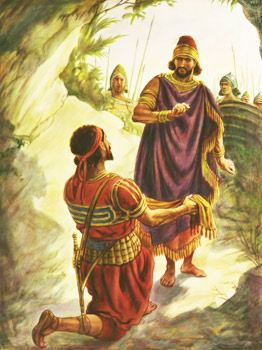
He said to David, "You are more righteous than I, for you have repaid me good, whereas I have repaid you evil." In the world, we often see obsessions as evidence of sickness. The classic example of Ahab and Moby Dick has reached so far into our lexicon that many use the expression "white whale" without knowing the whole story. Saul was obsessed with killing David, though David had done nothing but good to him. There was the prophecy that Saul's line would not keep the kingdom, and only Saul seemed unable to accept this truth. Even Saul's heirs knew that David was God's choice. Saul's whole focus was not even the kingdom he had been anointed and charged to protect and serve, but the title itself.

Saul's vision away from God was not turned when David entered his life. No, he lost the kingdom when he disobeyed God by making the sacrifice without Samuel (1 Samuel 13). And why did he do that? Because he was afraid the people would run away from him before he could get them battle. That seems like a reasonable fear, but he was expected to trust God first, not the fears of those who followed him. His impulsiveness cost him the kingdom, and though he knew it was lost to him, he continued to act as if it was his to lose, not God's to give.

David, though anointed, did not pursue the worldly gain of being king, but only the heart of God. He had reason to fear and perhaps some might say that he had reason to doubt the Lord because he was hounded by a man who was, for all intents and purposes, crazy. But he continued to trust in God, and even when he had the opportunity to kill Saul, he didn't.

David could have seized power as the world does, by killing the leader and taking over. But he chose obedience instead, refusing to strike "the Lord's anointed." He would not lead God's people the world's way. He would wait on the Lord, and when God put him on the throne, he would keep in promises, even to wicked, crazy Saul.

Lord of all power, God of strength in our weakness, grant us hearts that pursue you before everything. Kindle in us the fire of your love and presence, that our only obsession is You. Amen.

Friday, August 09, 2013

A Fine Primer Despite the Editing

I just finished a short book titled The Jesus Prayer by one Billy Kangas. It is an ebook that can be found at Feedbooks. It is 24 pages in length (though several pages are devoted to a bibliography and endnotes), and serves as a fairly good primer for the short, powerful prayer used by contemplatives the world over.

Mr. Kangas gives a nice accessible introduction to the prayer, providing information on its origins and use. While I might have wanted more history, here is just enough information to set the prayer into a clear context part of Christian trading without getting too academic. 

The prayer itself is not so much something one learns to do or say, but something one learns to incorporate into daily life, particularly for those who take seriously the biblical injunction to "pray without ceasing." Though the chapter on word meanings does not do much for me, the other chapters provide just enough information to keep interest and without bogging down the message.

My main problem with the book concerns the editing. I found several comma spices and run-on sentences, inconsistent punctuation regarding lists, a sentence fragment (not for emphasis), and the title of a book referred one way in the text and another in the notes. One or two of these mistakes are not that big a deal, but the cumulative effect is a little off-putting. 

But maybe I'm playing too much English teacher here. The book is free, so maybe I should not expect too much. I can attest to how hard it is be both writer and editor. The content is what matters, and if you are interested in contemplative prayer, this book is a useful beginning.

Friday, August 02, 2013

Meditation XXXII -- Bread of Life (5)

Simon Peter answered him, "Lord, to whom shall we go? You have the words of eternal life, and we have believed, and have come to know, that you are the Holy One of God."

A great deal could be and probably should be written about the things Peter said. He is a spiritual Everyman whose every word seems to be rich with meaning (even when he is putting his foot in his mouth). I think I have been drawn to him because he never seems to have a filter, and often says exactly what he thinks, from his heart. No, from his very being.

Here Peter does not say to Jesus, "You say some pretty smart stuff. We think you are kind of wise. And since we know you can feed thousands of people just like that, I'm sure we are probably doing the right thing hanging out with you." He answers Jesus' question with a question: "Where else would we go?" Then he succinctly states why Jesus in their choice.

Jesus has, in the discourse that precedes this conversation, whittled down his followers from a great multitude of people looking for the great Jesus magic show and banquet to a handful of faithful who are just beginning to see the difference between a great teacher and the one and only Messiah. In another place Peter reminds Jesus that they had put everything behind them to be His disciples. Here Peter gives the reason.

Had he stopped with "You have the words of eternal life, Peter would have been calling Jesus a great teacher. "We have believed" means that those men at that moment have been convinced that Jesus is One sent by God to redeem the world. The phrase alone is merely an intellectual assent. But the words "have come to know," placed in the context of Our Lord's declaration that He is the Bread of Life, gives us insight into what Jesus was doing in the hearts of these few and faithful, and to those who do more than look upon physical face of Christ.

Jesus has become part of them, as much as they were able to take Him in. Nothing could shake The Lord out of them. Even the threat of death or the supposed reasoning of wise men and philosophers could not move the Bread of Life from their very being anymore than cutting one's hair could keep a person from walking.

When The Lord died on the cross, Peter and the disciples would be emptied almost completely of hope. But at this moment, they were satisfied. After (and because of) the resurrection, they would be filled forever.
Oh Bread of Life, fill us with Yourself. Help us to do more than see and believe. Help us to know, and to make You known. In Christ Jesus, Amen.

Thursday, August 01, 2013

Meditation XXXI -- Bread Of Life (4)

"It is the Spirit who gives life; the flesh is no help at all. The words I have spoken to you are spirit and life."

When I coached young people in soccer, one of the basics I tried to instill in them was to face the ball. This is a little different from the "keep your eye on the ball" mantra for baseball players. The latter has the player focus on what the ball is doing. The former asks the player to focus on what she or he is doing in response to the ball. It works on a simple concept: where the head goes, the body will follow.

One of the hardest things to teach young soccer players is what to do when they are not near the ball. Good players know where to go and how to react when they are not directly involved in the play. Poor players find themselves watching as other teammates score or as the other team scores from where they were supposed to be.

The roads of life are overflowing with the corpses of those who made their bodies not temples, but gods. But Jesus is not just talking about the body as center of the universe, but the body as conduit for eternal life. We cannot find peace with the body alone because we then limit our search parameters to what we see and hear (and how we perceive what we see and hear) at any given time. Our spirits, on the other hand, are not limited, no matter what shape our bodies are in.

Our fleshly bodies must be trained to face Jesus. His words are spirit and life. His life is our bread. Remember that Jesus told this crowd that their ancestors ate manna -- food handed to them directly by God -- and still died. We must train our gaze, not only our fleshly ears and eyes, on the living Christ. When we do, the body will follow.

Lord Almighty, giver of all good things, feeder of hungry souls, shine your Light on us, and turn our faces to you. Amen.

Wednesday, July 31, 2013

Meditation XXX -- Bread of Life (3)

"For this is the will of my Father, that everyone who looks on the Son and believes in him should have eternal life, and I will raise him up on the last day."

So often when we ask about the "will of God" we are trying to find out what God wants us to do. Should we pursue a certain ministry? Who should we marry? How shall I deal with unbelieving co-workers? I know I have often reasoned that if God knows and cares about every hair on my head, then certainly even the smallest things should be put to the test of what He desires, assuming that even my failing hair is part of His greater plan.

Yet Jesus here does not subject us to such mental tyranny. I am not saying that we should not pray for God's direction, or that we should not wish to be part of God's work on the earth. But Jesus makes simple what we overcomplicate: Believe in Him.

Though I learned a lot in school about how food works to create energy, I do not think about the process most of the time when I eat. There are times when I do need to consider how nutrition works, so that I keep my body in good health. And I have realized over the years that my physical health is not just about how I feel, and that it effects many other people. But most of the time, I trust that when I eat, food will be converted into energy for me to get through to the next day.

Jesus, the Bread of Life, tells us to merely believe. Perhaps, in light of what I have already written, the word "merely" seems to be poorly chosen. Belief is often hard work. But is it harder than the mental gymnastics required to convince oneself that the center of the universe is in one's own brain?

It is not enough to turn our faces to Jesus. We can see Him and say, "Yes, He is a smart cookie, a wise fellow. He said some pretty bright things that sometimes apply to our lives." We must trust, when earthly reason fails us. And fail us it must.

We eventually are brought low, so low that eternity is something we cannot see, even with 20/20 vision. That is only one of the times we must look on the Son and know we will be raised.

Ever bright Jesus, guide us to right reasoning, that whether in action or stillness, we follow Your star. Amen.

Tuesday, July 30, 2013

Meditation XXIX -- Bread Of Life (2)

"This is the work of God, that you believe in him whom he has sent."


When I became a Christian, I never would have imagined that belief would be work. It seemed so easy, so natural. And I suspect that for most Christians, belief that Jesus is the Messiah, the Savior of the world, is quite natural, like turning one's head to look at the face of one whose voice has been speaking from the side.

But belief in Jesus is more than this. Imagine that the voice to our side is loving relative, perhaps a grandmother. My grandmother was one of the smartest people I knew. I was interested in what she said even when I become an all-knowing teen or an "I've-got-my-own-ways" young adult. When she spoke, I listened, partly because I loved her, but so often because she was so wise. She rarely gave me advice, yet spoke to me candidly, not only from her heart, but often from my own. How she did that, I don't know.

I rarely had the opportunity to disobey her, probably because I don't remember her telling me what to do. I treasured not only her words, but what I was to her.

Human wisdom, however, we can take or leave. Even the wise things Jesus told us we have ignored and not found ourselves in grave danger (or so we think). But Jesus, if He is to be believed, is not just a wise person, and not just a person who loves us even more than our grandmothers did.

Jesus requires action. No, He demands it. And that action is to know when other "realities" hit us that He is the Bread of Life. That He is the sustenance we need for eternal life. And not just life in some shiny gold Heaven, but LIFE instead of the death of separation from God.

See friends, our attention, like our faces, can be turned in many directions, to many different seeming realities. The runner believes that despite the pounding of his feet and knees on the earth, despite the more pleasurable activities of sitting in front of a ball game with a lap full of chips, despite the insistence of others that fitness can be accomplished many other ways, that the hard miles put in today will not only pay off tomorrow, but make each present moment better.

Faith in Jesus makes no sense to the world. To many (even some in the church), that faith is merely a step from one place to another. From one reality to another, like stepping through a wall to a new world. But faith isn't a step. It is a walk.

Lord Jesus, you offer always to feed us with Yourself. Help us to stay turned to You, and to walk always in Your Love. Amen.


Monday, July 29, 2013

Meditation XXVIII -- Bread Of Life (1)

"Do not work for the food that perishes, but for the food that endures to eternal life, which the Son of Man will give to you."
 
As I write this, I am housesitting for my brother and his wife, a kind of working vacation for me. I've been told that we can eat whatever is here, and there is plenty. And I love to eat. I really do, and my brother's home is well stocked. There is a great deal that might be called indulgences, and plenty that is "good for you." But for me, all food is good. I often say, "I haven't met a cheeseburger I didn't like."

And I know what it is like to be hungry. Not hungry like the homeless or like starving children in third world countries. But I've done without, for a variety of reasons. I have let myself be cranky when I have food, but not what I really want and no money to buy what I crave. And thinking about the homeless and the starving children often chastises me, but sometimes it just makes me feel stupid.

We need food, I want to tell Jesus. We die without it.

But we die, really die, without the Bread of Life.

So I must put this directive from Our Lord into context. Jesus had recently fed five thousand people from a small amount of food (maybe enough to feed one family). Then some of them go looking for him and realize that he is not there and he didn't leave with his disciples. So the crowd Jesus is now talking to have taken the time and effort to find him, and they have been at least partial witnesses to two miracles (though how much of those miracles they saw is not at all clear).

And Jesus says to them, "You came only because I filled your bellies." Well, yes. Isn't it human nature to go where the food is? Without food, we die. 
 
But Jesus isn't so much admonishing, but correcting them. And correction is not about being "wrong," but wrong-minded. Of course food is necessary. These people aren't lazy blights on society that are not willing to work in order to provide their sustenance. But where else can they eat and hear His teaching? The problem is they are still focused on their bodies and neglecting the spiritual aspect of life that is the center of The Lord's message.

He says, "You need to be fed. I am the food."

Just as the body can be tricked into thinking that a craving is a need, so our spirits can be tricked into thinking there is nourishment outside of Christ. There is some value to some things that are not directly from Jesus. But it is like the difference between canned peaches and the fresh fruit from the tree. And too often, we just want peach flavored gum.

Lord of all creation, source of all life, help us to recognize our craving for You. Remind us to taste and see that You are good. Amen in Christ Jesus.

Wednesday, July 24, 2013

Easy Rawlins, Nazis, and the Summer of Love

Cinnamon Kiss: A NovelCinnamon Kiss: A Novel by Walter Mosley
My rating: 4 of 5 stars

Cinnamon Kiss is the tenth book in Mosley's exciting Easy Rawlins series. Like the others, the novel is filled with interesting characters (other than the world weary protagonist and his dangerous friend Mouse), deft plot twists, and a bit of philosophy.

In 1966 Los Angeles, Easy, trying to raise money to save his adopted daughter, has to choose between helping Mouse pull off the heist of an armored car or taking a case from a man who isn't forthcoming about what and who are involved. The more Rawlins looks into the case, and the woman called Cinnamon, the more he feels he must get to the bottom of everything for more reasons than money.

The novel is fast paced, even when Easy is spending time thinking, and there is plenty to interest any reader. There is a generous amount of sex, betrayal, a heartless killer, hippies and even Nazis!

My main concern about Cinnamon Kiss is that Mosley, a skillful writer of well-crafted tales, spends too much time in the telling mode concerning "how it was in those days" for African Americans. One or two sentences are fine, but Mosley could easily have allowed the details of his story to provide that information instead stating it over and over. Had he done so, I think the impact of this important message would have been much greater.

This problem isn't likely to bother everyone, however. The book, as with so many of Mosley's, provides readers a necessary, but neglected history. I also love watching the fascinating mind of Easy Rawlins at work here. Fans of the series should enjoy Cinnamon Kiss. Those who have not been introduced to Walter Mosley (where have you been?) should also find good reading in this part of the saga.


View all my reviews

Monday, July 22, 2013

I want to be a fan of this book

not a fan. Becoming a Completely Committed Follower of Jesusnot a fan. Becoming a Completely Committed Follower of Jesus by Kyle Idleman
My rating: 4 of 5 stars

I generally hesitate to write about books on spiritual matters for a number of reasons. I won't outline them all here, but suffice it to say that I don't pretend to have expertise in theology and don't have the desire to argue with those who know even less and wish to engage me in their futile battles. As Timothy wisely instructed, "Have nothing to do with foolish controversies; you know that they breed quarrels." And too many people love quarrels.

But this book has struck a couple of nerves in me, so against my better judgment, I'm offering a few thoughts.

Idleman's book is dangerous for a few reasons. One of those is good. It's main message, that following Jesus is much more than putting a bumper sticker on a car or heading to church on Sunday is absolutely right, and if people who claim to be Christians actually followed Jesus, they and the world would be radically changed. That's the good news.

The book also sets up an either/or dichotomy that may not be healthy for many people either emotionally or spiritually. Idleman does not acknowledge that spiritual life is a journey, not a one time decision made, and once made makes one the exact same person as everyone else who has made that decision. Further, while there are a number of inspiring examples of how people have recognized the difference between being a fan and being a follower of Christ, much of the book implies that a true follower sees everything as Idleman does. He leaves no room for people in various stages of spiritual development or from different cultural backgrounds or with different modes of support for spiritual growth.

All that said, I do want to get back to the main message of the book: that following Jesus requires real commitment and that this commitment is what Jesus expects, not just lip service or a t-shirt. As I went through the book, despite my misgivings, I felt that this basic truth was not only solid, but what the world needs to hear. The world needs the real Gospel, not a watered-down, or politicized version of it. And the book, on the whole, encourages this. I felt I might be on the verge of a modern version of The Cost of Discipleship. (I was surprised that Bonhoffer's great book was never mentioned in not a fan.)

The book is well organized, and while it doesn't really offer a "how-to," it does give quite a few "reasons why." The chapter on the Holy Spirit was probably the most important part of this book. I wish the author had spent more time on this aspect of spiritual commitment. Nevertheless, I do recommend reading this book, even though one may want to keep a few grains of salt handy. It opened an important dialogue for me.

View all my reviews

Adams' Trios Two a Second Helping of Delight Pie


John Adams is not only an extraordinary bassist, making each tune he plays fuller and heavenly, but he is also a terrific bandleader. This release is the second he has produced featuring some of the trios he has played with in the past few years. Trios is one of my favorites among his recordings, but this project surpasses even that disc.

The first six tracks feature the piano, with Lee Tomboulian and JT Thomas on keyboard and drums for the opener "Love For Sale," and Brian Piper (piano) and Mike Drake (drums) on the next five tunes. I've been fans of Piper and Drake for some time, and they surely don't disappoint here. I strongly recommend getting the digital version of Trios Two because it contains sterling renditions of "Norwegian Wood" and "The Lady Is A Tramp" which cannot be found on the CD.

Mike Drake also plays on the next three tracks, which present Jason Bucklin on guitar. All three tunes are delicious, but my favorite slice of delight pie is the transcendent "Alice In Wonderland."

The late (and very missed) sax giant, Marchel Ivery, closes this set with Ed Soph taking the drum chair on "Bye Bye Blackbird" and "Giant Steps." Ivory rides these tunes like the mad conductor of a runaway train. I'd ride anywhere with these three.

Trios Two is not just a "standards" album. These tunes may never get old, particularly for jazz fans, but John Adams and his crews keep these songs -- and the heart of this reviewer -- very young.

Sunday, July 21, 2013

Still a lot unknown

Cloud of UnknowingCloud of Unknowing by Unknown
My rating: 3 of 5 stars

Even the anonymous author of this book says that it should be read more than once, and that it isn't for everyone. I found myself often going between wonder and wandering of mind as I worked my way through.

I must confess that I did not read A Cloud of Unknowing correctly. First, I looked for something to enhance or encourage my prayer life. The book, I'm certain, can do this, but it seems to be about more. Second, I after reading a few chapters and getting used to the difficult Middle Ages vocabulary, I began to read a chapter at a time at bedtime. Instead I should have either read as much as I could straight through, highlighting significant passages, or read a chapter a day in the mornings, when my reading mind is at its best.

The message of this treatise seems to be that God is not completely knowable, but that with prayer and meditation (and God's grace), one can get closer to knowing what God, in His wisdom, will reveal. Then the author, a leader of some sort in spiritual formation, outlines how to work at penetrating this cloud between God and humanity, and provides wisdom about the dangers and trials and benefits in such an important journey of faith. I recognize my reading is an oversimplification that may not be accurate. So be it.

I will need to read this important book again. Perhaps I was not as ready for it as I thought I was.

View all my reviews

Thursday, June 13, 2013

Meditation XXVII -- Our Weapon

For I do not rely on my bow,
   and my sword does not give me the victory.


Considering the turmoil in our country over guns and gun violence, perhaps this phrase seems apropos. We need to remember that weapons do not keep us safe or help us in our struggles, but only the Lord. But to look at this verse in this narrow light is to cheapen the richness of God's Word.

We use many weapons to overcome difficulties. Often we don't call them weapons, but think of them as tools. Some try to use their money to buy themselves into a sense of security. Some use their positions in business, church, or other groups to attempt to turn events and circumstances in their favor. Some use their physical prowess and skills to push solutions on all they come in contact with. Some -- like this writer-- will try to use their intellects and forget that even the smartest people have limitations. The Bible has too often been used to oppress rather than liberate.


A hammer can be used to kill as easily as it can be used to help build a house. It seems however, harder and harder for spiritually minded people to know when to set their hammers down, and trust the Master Builder.

I am mindful that the writer of this Psalm was well aware of the warrior culture and mindset he lived in. He fought in many wars and conquered many in battle, many who were larger, more agile, and more skilled in fighting than him. But he acknowledged that it was the God and Father of the universe that went before him, stood beside him, and healed his wounds. No matter what his abilities, no victory could come through his own powers.

Dear Jesus, make us mindful that there is no foe that cannot be conquered, and there is no true conquest without You. Build all the nations of our hearts with upon your foundation. Amen.


Thursday, June 06, 2013

A Tribute to the Voice, but Not the Playing

Before Nat King Cole became famous for his beautiful crooning, singing songs like "Unforgettable," "Mona Lisa," and "Route 66," he was the leader of a hot trio. That silky voice made people forget his prowess at the piano. I have noticed that many who know the music of George Benson have the same problem: they remember him singing such tunes as "Turn Your Love Around" and "This Masquerade." They forget his hit "Breezin" or his early work shredding Miles Davis' "Oleo" and "All Blues," or even trying on Wes Montgomery's "Four on Six." Remember that great part of "On Broadway" that is equal parts guitar solo and scat?

Hence, while I find this project, where Benson pays tribute to the Nat King Cole, enjoyable, I am disappointed about what is not here. I'm sure I'll be in the minority, but I would love to have heard at least a couple pieces from Cole's pre-singing catalog. Failing that, I would like to have heard more of Benson's guitar.

Make no mistake. George Benson still has a wonderful voice, and he does a serviceable job with these songs. Not only do we have sweet versions of ballads like "Too Young," "When I Fall In Love," and "Smile" (probably my favorite), but the peppier songs like "Route 66" and "Straighten Up and Fly Right" are given solid treatment and delivered with Benson's usual punch. But the guitar is all but absent. The solo on "Unforgettable" is mediocre, and the one on "Nature Boy" is nice, but too short. While the playing on "Straighten Up and Fly Right" is much closer to what I am used to from Mr. Benson, it meanders perhaps a bit. Other than a handful of acoustic flourishes on "Mona Lisa," that is pretty much all the six-string work listeners get.

The album is going to be very enjoyable for those who like the lush strings or big band arrangements one used to hear on Nat King Cole's most memorable performances. It is romantic and pleasant. But if you are looking for the George Benson whose fingers fly on the fretboard, you are not going to find much.