Friday, May 30, 2014

A Good Deal of Truth in the Fiction

The Ink Garden of Brother TheophaneThe Ink Garden of Brother Theophane by C.M. Millen and Andrea Wisnewski
My rating: 5 of 5 stars

This is a charming and delightful book about a daydreaming monk who discovers how to make different colors of ink to illuminate the books transcribed by he and the brothers in his monastery. As much about art and chemistry and poetry as it is about work and imagination, I could not stop smiling as I read the story and gazed at the illustrations. I may be 50, but I felt like a child as I experienced the wonderful tale.

After writing the above for Goodreads, I ran across another review which spens a great deal of space on the fact that the character of Brother Theophane was not a real person. And I think I can understand the writer's concerns, particularly about the story's impression on children. However, the version of Millen and Wisnewski's book I read contained notes at the end about how the character was a fictional recreation of what several monks had done in experimenting and "discovering" new shades and methods for illuminating manuscripts. (The poems in the book were also from a number of different anonymous monks.)  While I too am troubled by the idea that discovery is some solitary action done by one smart or brave soul, I also believe that one should not be troubled so much by this book.

The story and the character are truer in the sense that all great fiction is true: it tells about humanity in all its imperfections and potential. Brother Theophane may not be a single real person, but he is at the heart of many people's experiences and hopes -- then and now.


View all my reviews

Wednesday, May 07, 2014

Where were you when you were here?


It is nearing the end of another semester, and once again, the expressions of frustration are pouring forth from instructors and students alike. Many students feel overwhelmed and lost as they prepare for exams over material they claim was never covered and finalize papers whose parameters often remain a mystery. Teachers try to hold in painful sighs as they repeat information for tenth time this week for this one class, and bite their collective tongues at the students who are just now realizing they have zeroes on some assignments or have suddenly become privy to the attendance policy.

Sometimes I want to shout, “Where were you when I covered all this information? What were you doing while the whole class was doing research on this? What were you listening to while I darn near begged students to see me during my office hour or go to the Writing Center for help?

I know when people miss a lot of classes, I can point to lack of participation as a reason for poor grades and an absence of learning. But so many students are physically present, but not really “there.”

So I propose to answer some of these questions in the hopes that if you are student who seems to be missing something, you can learn to “Be here now,” as one of my own professors cautioned me. And if you are a teacher, you probably won’t feel better, but at least you will know what to watch out for.

Where were you when the teacher covered that in class?

  • Texting your friends.
  • Checking your Facebook 
  • Chatting with your neighbor.

Where were you went the instructor offered to answer questions about the assignment or explained the assignment for the third time?
  • Asking the guy next to you for clarification. You know, that dude who barely speaks or understands English, but has a nice smile? 
  • Talking to that woman who seems smart because she always remembers her book, but is lost in her own problems?
  •  Grinning at some YouTube video on your laptop.

Where were you when the rest of the class was completing an in-class assignment?
  • Checking Wikipedia for some information on the subject.
  • Making an outline of the paper you should have completed a week ago. 
  •  Checking your grades for another class.

Where were you when the teacher set aside class time to do research in the library?
  • Studying for a test in your next class by staring at random pictures in the textbook.
  • Playing Candy Crush as you wait for an opportunity to sign the roll sheet.
  • Driving your car to Taco Bell convinced today was a “free period.”

Where were you when the professor was explaining how your final grade is figured or when he was giving the class information about the Final Exam?
  • Packing your bags to leave.
  • Wondering what this guy is talking about and why he thinks it is so important. (It is a particularly bad sign if you are wondering who this guy is.)
  • Checking your notebook or folder to see if it is too late to drop the course.
Where were you just before you asked the instructor about extra credit?
  • Noting for the first time this semester that you have seven zeroes in the grade book.
  •  Posting a Facebook status about your unfair teacher.
  • Listening to other classmates talk about excuses they used to get extensions on assignments.
  • Trying to remember whether your grandmother has already “died” this semester.
  • Searching RateMyProfessor.com for “better” instructors to take in the fall.

Certainly the above does not represent all undergraduates. Some weak students make an effort to figure out what is going on, and plenty of good students lose their way now and then. And I know there are teachers who operate under the “I said it; therefore I taught it” pedagogy, and so they have no idea what actually “works” in a classroom, and thus short change the whole system. But every semester, I find more students walk onto campus already tuned out, blaming the subject matter for being boring (instead of their vapid lives), and expecting teachers to entertain them (or at least tolerate their raging apathy).

The problem isn’t all about the students either. The actions and attitudes noted above indicate a growing trend of nearly militant ignorance. Many of our college students have failed themselves, but have also been failed by their parents, teachers, administrators, friends, and politicians who know nothing about education, but seem perfectly willing to make up rules about it while stripping funding from everything except football and stealing power from all who can make education in this country the envy of the world again. But the past, no matter how recent, is no excuse.

Students need to imagine the actual piece of paper we call a diploma. The name they see will not belong to all the people who had a role, for good or ill, in the education that paper is supposed to represent. And that education, if it is to be worth something, needs to start with students doing more than getting marked “present.”

Wednesday, March 19, 2014

Meditation XXXIV--The Love of Argument


Avoid the irreverent babble and contradictions of what is falsely called "knowledge," for by professing it some have swerved from the faith.

Much of this letter from Paul to Timothy is about people who, it seems, love to argue and stir up controversy. Sure, there are those who believe something (even false things) and also believe it is important to fight what they believe is "the good fight." They may even quote the verse about that fight when defending their vision of what is right or true. But they neglect the verse that comes before it: "Pursue righteousness, godliness, faith, love, steadfastness, gentleness."

Of course believers should defend the Gospel, right orthodoxy, and the Christian life. But when our arguments pull us away from that Gospel, the good news, and the life we are charged with, then we are better off shutting up and letting opponents think they are right. Truth will win out. Maybe not today. However, as disciples of Christ, we must trust the God of Truth.

All the Bible verses we memorize will do us no good if we shame the Lord by neglecting his commands as we speak. The devil knows the Bible too, and he delights when anger and self-righteousness pull us away from the love of Jesus.

Lord, as I study your Word and strive to live your Way, let me not become puffed up, but help me to stay close to you, and to meet with your Love those who disagree with me. In the Name of the one who died even for the ones who do not love me, Jesus Christ my Lord. Amen.

Tuesday, March 11, 2014

God Particles: PoemsGod Particles: Poems by Thomas Lux
My rating: 4 of 5 stars

Mr. Lux never ceases to astound and delight me with his mastery of surreal landscapes and the possibilities of language. I don't always "get it," but I always want to.

This collection seems more personal than others, but I confess I am not sure how I would know. It isn't that there are so many voices, but the same voices speaking from different perspectives.

The title poem is a gem.

And speaking of gems, one should never say of Lux's poems that they are diamonds in the rough. In his world the diamonds are rough, and sometimes the rough shines.

View all my reviews

Monday, February 24, 2014

Warmth and Bite

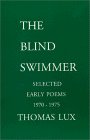
The Blind Swimmer: Early Selected Poems 1970 - 1975The Blind Swimmer: Early Selected Poems 1970 - 1975 by Thomas Lux
My rating: 4 of 5 stars

Clearly Mr. Lux has been writing surprising and thought-provoking verse for many years. This little collection demonstrates the strange combination of charm and shocking imagery that would become even more pronounced in his later poems.

It is difficult to compare Thomas Lux to anyone because his work is so unique, but it is not uniqueness for its own sake. There is warmth and bite here, like the cat that purrs and scratches, and leaves you to figure out how the motivation for both is the same.


View all my reviews

Friday, February 07, 2014

Not Holding Fast


Paul warns the Colossians against people who are “puffed up without reason by his mind, not holding fast to the Head.” I see this in those who have stolen the language of religion to create a formula, an equation for hate in no way in line with the Gospel of Christ or the Scripture they claim to live by. These would create burdens for others they would not lift themselves.

But before I judge them, let me check myself that I do not allow the devil to create in me merely a member of an opposite faction, weaponizing the Holy Word for my own gain.

The reference to Jesus as our “Head” ends this way: “from whom the whole body, nourished and knit together through its joints and ligaments, grows with a growth that is from God.” May we all find our nourishment in Him. May we allow Him to put us together before we stumble out to do battle against our own bodies.

Tuesday, January 28, 2014

Making Useful Connections

The Tipping Point: How Little Things Can Make a Big DifferenceThe Tipping Point: How Little Things Can Make a Big Difference by Malcolm Gladwell
My rating: 4 of 5 stars

In my writing classes, I often have to tell my students that cause and effect connections are difficult to prove. I may have to encourage them soon to read this book to help them learn the sort of critical thinking required to look at problems and come up with and communicate viable solutions.

At first glance it may seem that Gladwell's connections are silly or oversimplified. But they not only work, and not merely as some intellectual exercise. He demonstrates the complicated relationships between actions and events. The book also illuminates the potential humans have for problem solving. This is a book that should be required reading, particularly for managers and administrators. It certainly can be a boon to those who wish to improve critical thinking skills.

View all my reviews

Monday, January 27, 2014

Augustine's Confessions

Confessions (World's Classics)Confessions by Augustine of Hippo
My rating: 4 of 5 stars

This is a magnificent book. Well, parts of it. Augustine's actual account of his life is beautiful and stirring. I was particularly struck by his love of his mother and his friends.

But when he gets into his ruminations about time and all that, I kept thinking, "What does this have to do with his conversion or his spiritual and intellectual growth? Shouldn't this be in another book?" Maybe that is modern impatience creeping in on my part.

Yet it is all worth it to see not only his devotion, but honesty. More Christian writers, especially memoirists, would do well to read this before thinking their journey is all that special. And even those who are not Christian could benefit from Augustine's story and reasoning. His faith comes not from backwoods ignorance, but from careful thought and an open search for the truth.

View all my reviews